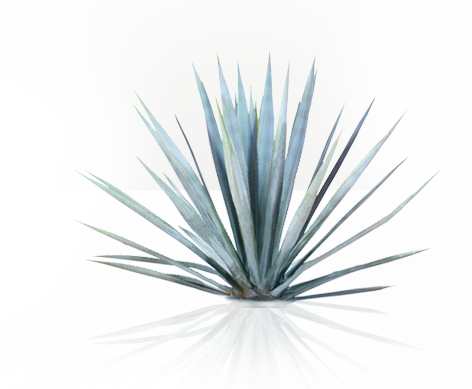
According to the Tequila Standard, only Tequilana Weber blue variety Agave may be used for the production of Tequila.
These Agaves must be planted within the territory protected by the Appellation of Origin, as well as being included in a registry of plantation controlled by the Tequila Regulatory Council.
Many different types of agave exist. In Mexico alone more than 200 hundred varieties have been identified. However, none is as suitable for the production of Tequila as the plant that was classified in 1905 by the German botanist Franz Weber, from whom this variety took its name.

The Agave is planted in parcels in forming neat rows leaving sufficient space between them to facilitate the care of the plant.
Normally, the Agaves reproduce through shoots that grow out of the mother plant from the fourth year onwards and are separated and later transplanted onto other fields already prepared for their cultivation. Nonetheless, the Agave may also grow from a single seed, although this technique is not very common nowadays.
The Agave requires from 6 to 10 years to reach its maximum sugar concentration. During its period of growth, the plants are subject to pruning or trimming of the tips of the leaves to favour the growth of the head.
All of the care and cultivation of the Agave is done manually following traditional methods that have been passed down from generation to generation.
For the production of Tequila, only the head (piña) is used. It can weigh between 40 and 60 kilograms once it is ready for harvest.